
22 hours ago
I'm weird, therefore my creation is as well

When I started designing my own programming language, I wanted to give it a unique flavor. Generally speaking, any software one builds will eventually be a representation of its creator in one way or another.

In my case I wanted to syntactically make some things different as people are used to. Normally, if you are going for wide adoption, you'd make a language so that is can be quickly learned. The faster you can learn a language, the faster you can start building actual things. Likewise, people will be accepting much more of course. Why bother with a language whose usage is a pain in the ass?

However, while I really like the idea of building something that is widely adopted, I was sure that it wouldn't happen with my language. Designing and building a language that is fast and efficient is not a trivial task. There is a reason why only few people do it. It IS rocket science in comparision.

So, instead I focused on the following goals:
- Put in as much representation of me as possible
- Make it a full working replacement of Cmd/PowerShell for my own use
# Declaring and initializing a constant

const SOME_CONSTANT int <= 10;

# Declaring and assigning a global variable value

global myGlobalVar bool;
set myGlobalVar <= true;
Also I made it so that the type of an entity comes after its name. This applies to constants and variables (as seen above), but as well as functions or in OOP constructs.
# Sample of a function implementation
# Perform addition using a local variable and parameters, and set as function result

function MyTestFunction int(param1 int, param2 int)
{
    local myLocalVar int;

    + myLocalVar %param1 %param2;
    result %myLocalVar;
};
# Class implementation example

class CMyClass {
    member mTestVar string;

    method construct void()
    {
        set %this.mTestVar <= "Hello World!";
    };

    method MyTestMethod void()
    {
        print "%%this.mTestVar";
    };
};
As for if-statements I wanted to go with parametrized comparision operators, as you may know from PowerShell. This was also decided because all operands and the operator are separated via commata in order for the parser to recognize them. So, in that situation it feels weird to stick to the most common operator identifiers.
# If-statement, including elseif and else.

if (%myValue, -gre, 1) {
    print "Greater or equal to 1";
} elseif (%myValue, -eq, 0) {
    print "Equal to zero";
} else {
    print "Obviously less than zero";
};

# For-loop
for (i, 0, 10, -inc) {
    print "Current value: %i";
};
You will most likely also have noticed the semicolon after the curly brackets. The scripting language is command-based. Each interpretable line is a command plus optional arguments. Commands are separated by a semicolon. So, if-statements, loops, functions are complex nested commands that require the semicolon at their end. This approach serves the following purpose: Make the interpreter easy to be implemented while allowing complex, nested script code.
I'm pretty sure, you know see what I mean when I say that my programming language is weird. You may also see that it's inspired by other languages, such as C++, PHP, Tcl and PowerShell.
It's funny tho, because sometimes doubtful thoughts come to mind, like, I should change the syntax so it reflects the crowd. But now, I'm not going to do that. I want to accept my weirdness. My programming language is an almost therapeutic way to practice it.
And the language works very well for what it's designed for, automation tasks and scripted applications. Like it was done with AutoIt or AutoHotkey.
Want to see what I've build with my own programming language? Go ahead:
- 23 automation and administration snippets
- Full working Twitch Chatbot
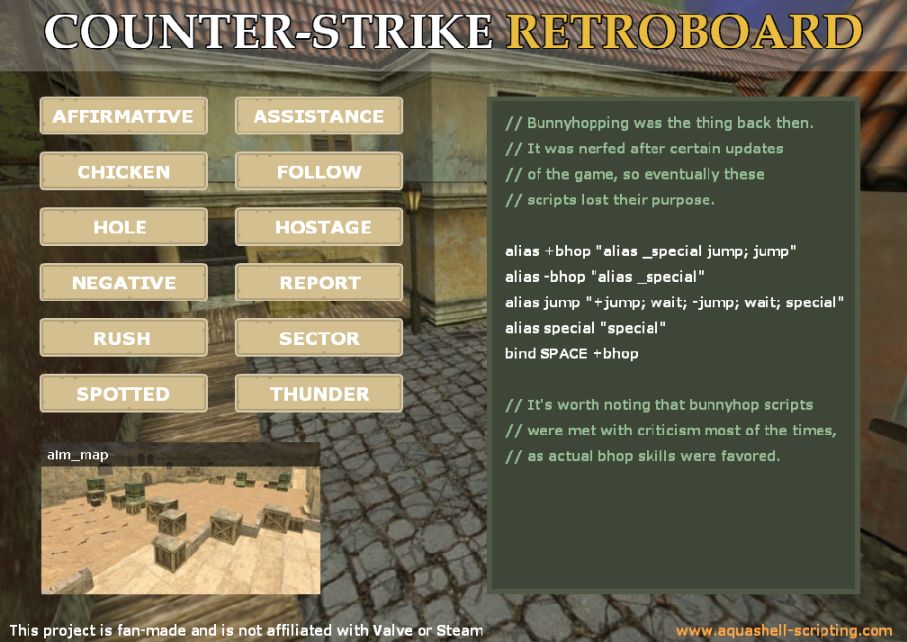
- A Counter-Strike 1.6 Retro App
- A photo bot for your Discord server
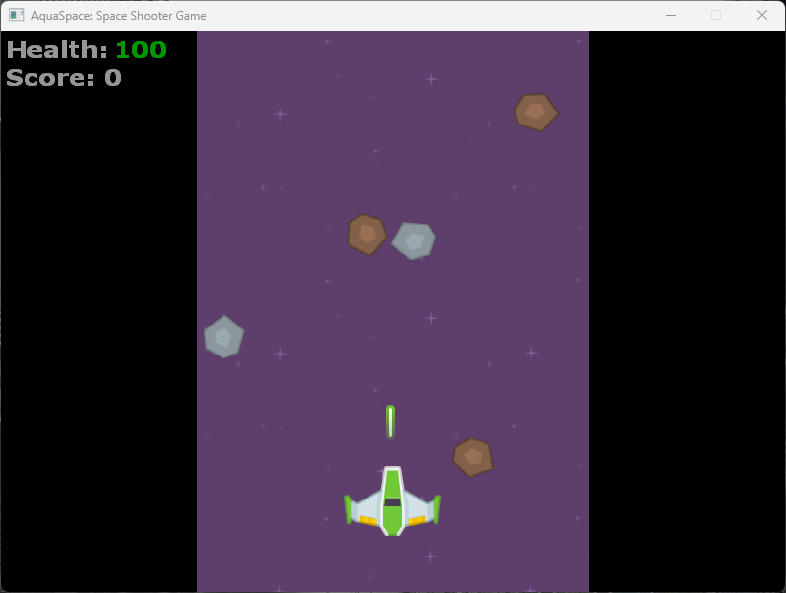
- A demo asteroids game (2D)
 https://danielbrendel.itch.io/aquaboard-csrb
Asteroids game
https://danielbrendel.itch.io/aquaboard-csrb
Asteroids game
 https://danielbrendel.itch.io/aquaspace-game
If you want to check out my related projects, see the following links: ✨The scripting interpreter for your own C++ projects ✨The scripting and automation shell for Windows More info on the official AquaShell homepage: 🌐 https://www.aquashell-scripting.com